
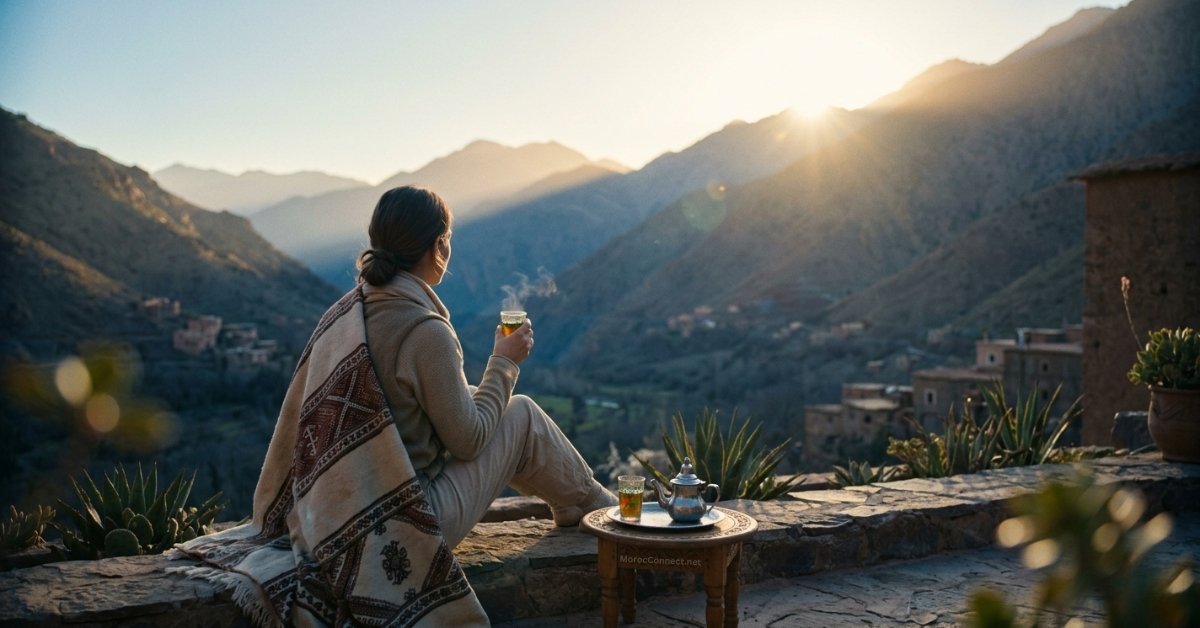

Morocco Quietcation: The Hushpitality Frontier That’s Changing How the World Travels
There’s a particular kind of exhaustion that no amount of sleep fixes. You know the one — scrolling at midnight, inbox pinging at breakfast, your brain still processing Tuesday’s meeting at 3 a.m. on Saturday. It’s no coincidence that the number one reason people are booking international travel in 2026 isn’t adventure or sightseeing. According to Hilton’s global 2026 Trends Report, a full 56% of leisure travelers say their primary motivation is simply “to rest and recharge.” The buzz phrase the industry has landed on is hushpitality — and Morocco, specifically the Atlas Mountains and the Draa Valley, is quietly becoming its world capital.
This isn’t just a wellness trend dressed in hashtags. It’s a structural shift in how people think about time away. And Morocco’s ancient landscape, built on silence long before “quietcation” was coined, is perfectly positioned to meet this moment.
What Is Hushpitality — And Why Does It Matter Right Now?
Hushpitality refers to a hospitality philosophy centered on deliberate quiet: environments, itineraries, and accommodations designed to reduce sensory input, eliminate decision fatigue, and allow the nervous system to genuinely recover. It goes beyond “no TV in the room.” Think no loud lobbies, no event schedules, no performative wellness programming — just space, slow meals, and honest silence.
The concept pairs tightly with the quietcation — a vacation built not around what you do, but around what you finally stop doing. Travelers on quietcations intentionally go offline, often choosing destinations where poor cell service is a feature, not a complaint. The data backs this up hard: industry analysts and leading travel forecasters point to 2026 as the year “slow, intentional travel” officially overtook bucket-list tourism as the dominant Western travel motivation.
Morocco’s sell here isn’t manufactured. The silence in the Atlas Mountains isn’t engineered by a resort architect. It was already there.
The Atlas Mountains: Altitude, Architecture, and the Sound of Almost Nothing
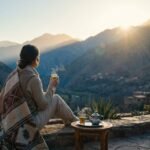
Drive 90 minutes south of Marrakech and the entire register of sound changes. The medina’s motorbikes and call-to-prayer overlap, the carpet-seller’s pitch, the relentless stimulation of Morocco’s cities — all of it drops away. What replaces it is wind moving through cedar, the distant percussion of a shepherd’s bell, water over stone.
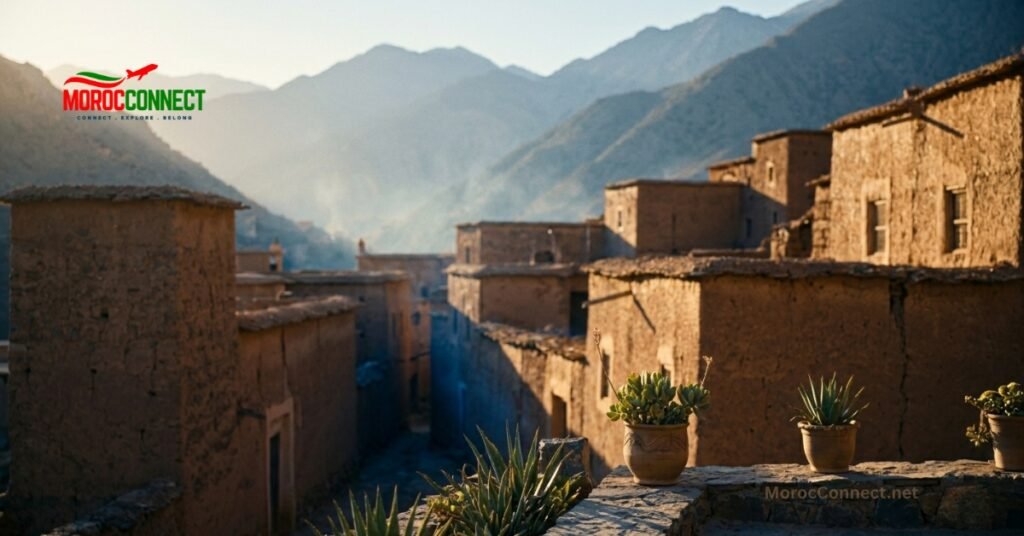
The High Atlas is one of Africa’s great mountain chains, stretching across Morocco’s spine and separating the Atlantic coast from the Sahara. At its peak, Mount Toubkal climbs above 4,000 meters. But you don’t need to summit anything to understand why people are increasingly booking a week here with no particular agenda. The Berber villages perched on ridgelines — Imlil, Aremd, Tacheddirt — are places where the architecture itself enforces quietness. Thick-walled kasbahs built from pisé (rammed earth) absorb heat in summer and hold warmth in winter. Their courtyards face inward. There’s almost no wasted space, no decorative noise.
Why the Nervous System Responds Here
The science of why natural settings at altitude accelerate stress recovery is reasonably well established. Reduced barometric pressure, cleaner air, lower ambient noise levels, and the visual experience of uncluttered landscape all contribute to what researchers call attentional restoration — the brain’s ability to rebuild focused capacity after extended periods of overstimulation. In plain terms: nature at this scale gives your mind something large and uncomplicated to rest against.
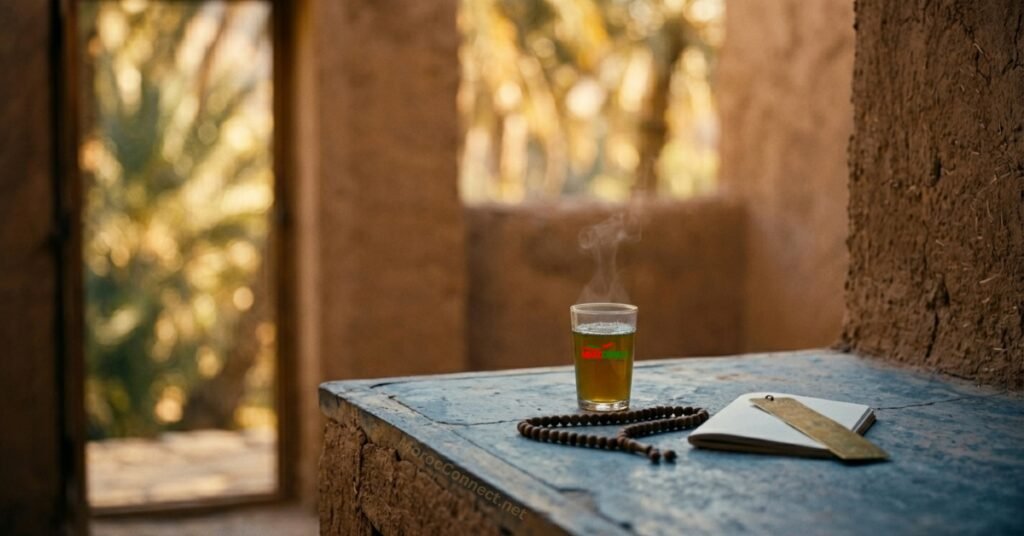
The Atlas takes this further. Berber hospitality — amazigh culture — is built around a rhythm of tea, conversation, and unhurried meals. No one is trying to optimize your stay. When your host pours the third glass of atay (Moroccan mint tea) and gestures toward the mountains without saying anything, that is the program.
For travelers seeking a Morocco quietcation, the valley routes are as valuable as the peaks. The Ourika Valley, the Aït Benhaddou corridor, and the high pastures around Oukaimeden all offer multi-day immersion without requiring serious trekking credentials. Village guesthouses — converted in recent years as part of Morocco’s Go Siyaha rural tourism initiative — provide authentic stays where evenings are genuinely dark and mornings genuinely quiet.
The Draa Valley: Morocco’s Most Underrated Silence
If the Atlas Mountains are now attracting savvy quietcation travelers, the Draa Valley is where the truly serious ones go.
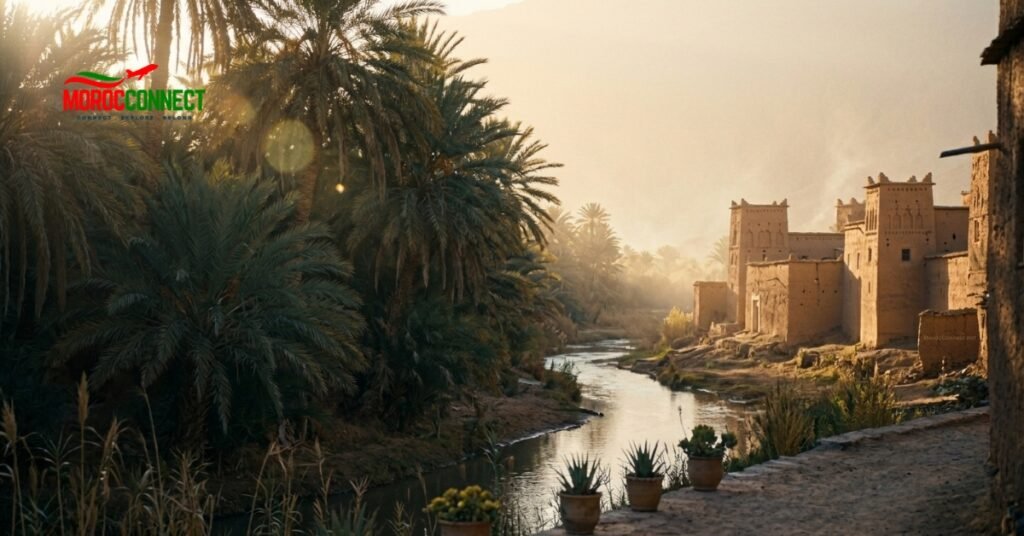
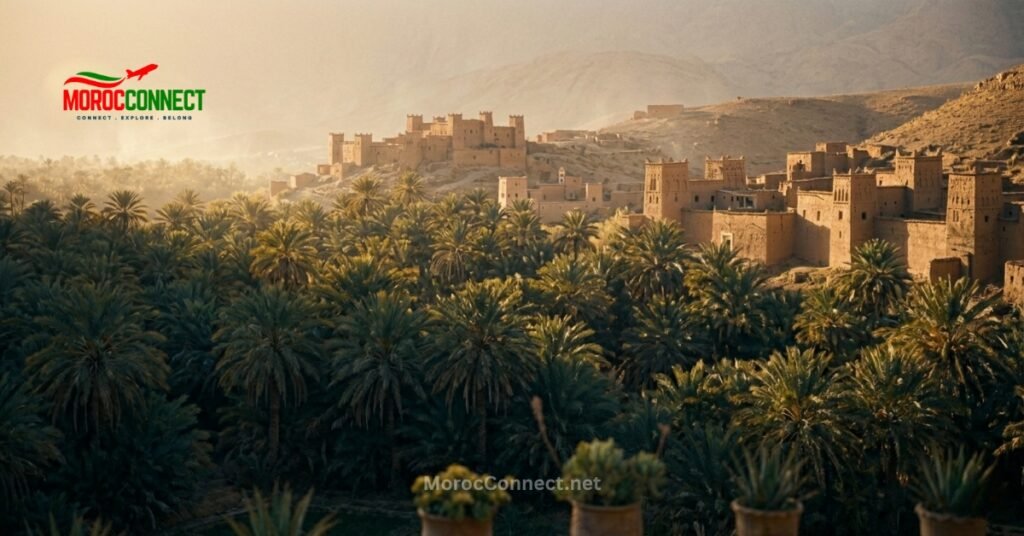
Running some 1,000 kilometers south from the High Atlas toward the Sahara, the Draa is Morocco’s longest river valley and one of the most atmospherically singular places in North Africa. Ancient palm groves — some dating back to pre-Islamic trade routes — line the river in dense, rustling corridors. Mud-brick ksour (fortified villages) rise from ochre hillsides. The light is different here: heavier, golden, and with a quality that slows even your gaze down.
The valley’s main town, Zagora, sits at the edge of where the Sahara begins to push north, but the real draw for nervous-system recovery travelers isn’t the dramatic dune landscapes. It’s the middle sections of the valley — Agdez to Nkob, in particular — where the combination of agricultural flatland, ancient date palms, and fortified kasbahs creates an environment of extraordinary visual and acoustic calm.
What Hushpitality Actually Looks Like Here
Several boutique properties in the Draa Valley have developed what can genuinely be called hushpitality architecture: guesthouses where the design itself does the work. High interior walls cut ambient sound. Rooms face gardens rather than roads. Meals are taken in covered courtyards where the loudest regular sound is birdsong from the surrounding palms. There are no scheduled group activities. You can hike out into the palmeries alone, sit by the river, or do nothing at all, and the property will simply make sure dinner is ready at dusk.
This is the product that a growing segment of international travelers is actively searching for, and Morocco — with its combination of accessibility from Europe, extraordinary natural environments, and deeply embedded hospitality culture — is positioned to deliver it better than almost anywhere else.
MorocConnect has been tracking the rise of quiet-travel demand across its booking data for the past two years, and the trajectory is unambiguous: searches for “Morocco retreat,” “Atlas Mountains slow travel,” and “Draa Valley private stays” have climbed sharply, with the strongest growth coming from the UK, France, Germany, and the United States.
The 2030 World Cup Factor: Book Your Quietcation Before Morocco Gets Loud
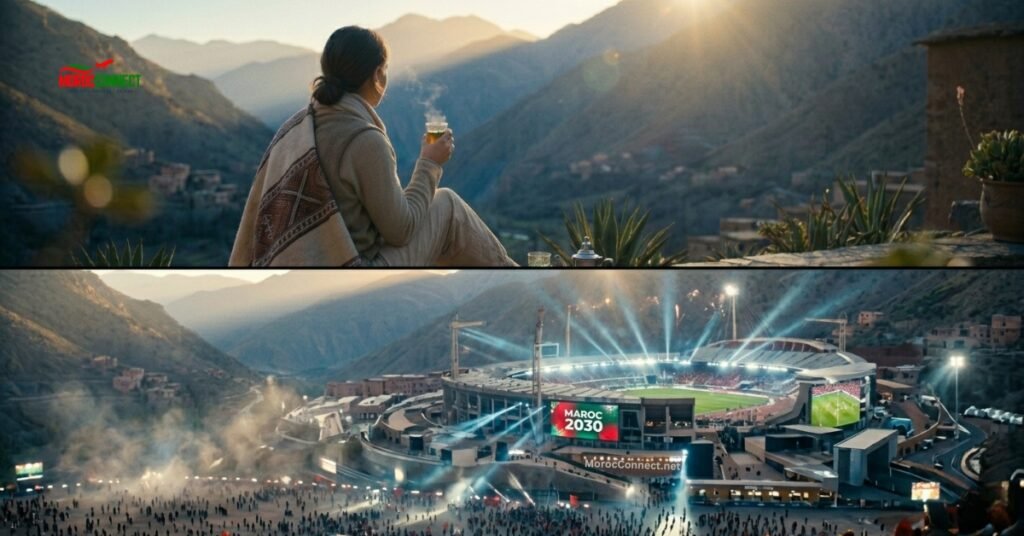
Here’s the part that adds some urgency, especially for soccer fans and travel-savvy deal hunters paying attention: Morocco co-hosts the 2030 FIFA World Cup, and everything about the country’s tourism infrastructure is currently being built out to accommodate that moment. New roads, expanded airports, additional luxury accommodation, improved rural connectivity — it’s all happening right now.
What that means practically is that the narrow window of “Morocco is easily accessible and still genuinely undiscovered in its quieter regions” is closing. The Draa Valley guesthouses that currently feel like a private discovery will not feel that way in four years. The Atlas lodge that’s a one-hour drive from a newly expanded Marrakech airport but still completely insulated from mass tourism will attract a very different kind of attention once the World Cup media cycle hits.
Travel veterans who lived through what happened to Tuscany after Under the Tuscan Sun, or to Lisbon after a decade of budget airline expansion, understand the pattern. The quietest version of Morocco’s quiet places is available right now.
Planning Your Morocco Quietcation: Practical Pointers
When to go: The Atlas and Draa are best between March and May, and again from September through November. Summer heat in the valley is serious, and winter at altitude can bring snow to the high passes. The shoulder seasons offer both access and the kind of clear, long light that makes these landscapes feel almost artificially beautiful.
How long to stay: A genuine nervous-system reset requires more than a long weekend. Budget a minimum of five nights — ideally split between the Atlas (two nights in a mountain guesthouse) and the Draa Valley (three nights in a palmery lodge). This gives your body and brain enough time to actually decompress rather than just change locations.
What to bring: Less than you think. One of the consistent reports from quietcation travelers returning from Morocco is that the environment does the work — you don’t need a curated reading list or a wellness protocol. Bring good walking shoes, a journal if that’s your habit, and a willingness to eat slowly.
Getting there: Direct flights from London, Paris, Amsterdam, Madrid, and multiple US gateway cities land at Marrakech Menara. From there, a private transfer or shared transport to either the Atlas or the Draa is straightforward. MorocConnect partners with vetted local transport and accommodation providers across both regions, making it easy to build a custom quietcation itinerary that actually holds together on the ground.
The Controversial Bit: Is “Hushpitality” Just Expensive Nothingness?
Let’s be direct about the pushback this trend gets. Critics — and there are plenty, particularly in adventure travel circles — argue that quietcations are a rebranded version of doing nothing and charging a premium for the privilege. That the hushpitality concept is essentially a marketing wrapper around “sit quietly, which you could do at home for free.”
There’s something to this. If you’re flying to Morocco to stare at a wall in a boutique hotel, you’ve missed the point and wasted a trip. But the argument misunderstands what the Atlas and the Draa actually offer. This isn’t passive nothingness — it’s active environmental contrast. The specific combination of landscape scale, cultural texture, altitude, and genuine human warmth that characterizes a well-organized Morocco quiet-travel experience produces something that sitting at home simply cannot replicate. The foreignness of the environment is part of the medicine.
A week in the Ourika Valley or the Draa palmeries will recalibrate something. Most travelers who’ve done it report a persistent shift in their relationship to pace that lasts for months after they return. That’s not nothing. That’s arguably the highest-value thing travel can deliver.
Finding Your Morocco Quietcation: Where MoroccoConnect Comes In

Knowing that the Atlas and Draa are the right destinations is step one. Finding accommodation that genuinely delivers on hushpitality principles — rather than just calling itself a “retreat” — requires ground-level knowledge that most aggregator platforms don’t have.
Explore MorocConnect’s curated Atlas and Draa Valley quiet-travel packages — built around properties that have been personally vetted for their silence, their hospitality, and their ability to give your nervous system what it’s actually asking for. Whether you’re planning ahead for the post-World Cup rush or want to move while prices and availability still favor the traveler, MorocConnect.net is where the smartest Morocco trips start.
The quiet is there. Morocco has been holding it for you. The only real question is when you’re going.
Ready to stop thinking about it and start planning? Visit MorocConnect.net for the latest deals, curated itineraries, and insider packages on Morocco quietcation travel — before the rest of the world catches on.


I’ve always felt a draw to Morocco’s landscapes, but I never considered it as a destination for quietness. This blog has completely changed my perspective—sounds like a much-needed retreat for anyone who feels burnt out. The tranquility of the Atlas Mountains must be unmatched.
The concept of hushpitality really resonates with me, especially given how hard it is to find true stillness in our digital age. It’s fascinating to see Morocco positioned as a quietcation capital, not just because of its natural beauty, but because of the intentional silence its landscapes offer. The idea that the Atlas Mountains and Draa Valley are leading this shift in travel philosophy is both refreshing and timely.